Where Home Prices Still Make Sense: 10 Underrated Neighborhoods for 2025 Buyers
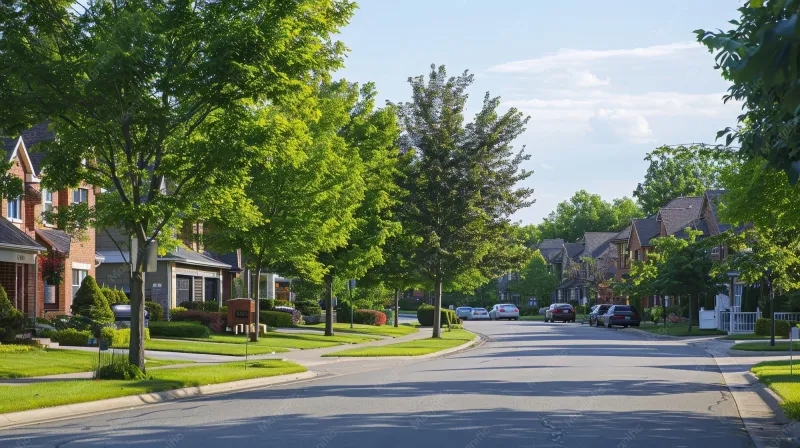
Photo: charming American neighborhood street with homes and tree-lined sidewalk, via img.freepik.com
The Affordability Story Nobody Is Telling
It has become fashionable to declare that homeownership is slipping out of reach for ordinary Americans. The national median price gets quoted, gasps ensue, and buyers retreat to the rental market. But national medians flatten out the very information buyers need most: geography. Affordability in 2025 is not a single number. It is a patchwork, and within that patchwork there are neighborhoods where your budget buys not just a house, but a genuine upgrade in quality of life.
At Saryak Realty, our agents work in these communities. The following ten neighborhoods combine below-market entry points, rising demand, and the unglamorous fundamentals — schools, commutes, amenities — that determine whether a purchase holds its value.
1. Rivermont, Chattanooga, Tennessee
Median prices here remain well under $300,000, yet the neighborhood sits minutes from downtown Chattanooga's riverfront redevelopment. Tennessee's absence of state income tax sweetens the math for relocating remote workers. Appreciation has run ahead of the metro average for three consecutive years.
2. Garfield Heights, San Antonio, Texas
San Antonio remains the most affordable of Texas's four major metros, and Garfield Heights delivers mid-century homes near the Medical Center corridor. Buyers get larger lots than they would find in Austin for roughly half the price, with the 1604 loop keeping commutes manageable.
3. Westgate, Columbus, Ohio
Columbus keeps landing on national growth lists, but Westgate flies under the radar. Solid brick bungalows, walkable access to Hilltop amenities, and a straight shot downtown keep prices in the low $200,000s while inventory elsewhere in the city climbs.
4. Avondale, Birmingham, Alabama
Avondale's dining and park scene has transformed the area, but housing costs have not fully caught up. Expect renovated craftsman homes in the mid-$200,000s, with strong demand from young professionals working in Birmingham's growing Uptown and health-care districts.
5. North Loop, Wichita, Kansas
Wichita's aerospace economy is quietly diversifying, and the North Loop offers some of the lowest price-per-square-foot figures of any urban district in the country. For buyers priced out of coastal markets, the arithmetic is almost jarring.
6. Frogtown, Toledo, Ohio
Adjacent to the revitalizing Warehouse District, Frogtown's historic housing stock trades at a fraction of comparable Midwest markets. Proximity to the University of Toledo and the Medical College supports a steady rental floor for investor-minded buyers.
7. Cedar Crest, Atlanta, Georgia
Everyone knows Atlanta's beltline neighborhoods are expensive. Cedar Crest, on the southwest side, offers 1950s ranch homes near the Westview corridor at prices the eastside last saw a decade ago. The Atlanta Streetcar extension discussions make this a bet worth watching.
8. Kensington, Philadelphia, Pennsylvania
Kensington remains Philadelphia's most talked-about transformation story. While Fishtown next door has priced out many first-time buyers, Kensington still offers rowhomes under $250,000 within a short EL ride of Center City.
9. Midtown, Reno, Nevada
Nevada's no-income-tax structure draws Californians north, and Midtown Reno delivers walkable breweries, galleries, and renovated motels-turned-lofts at prices that still undercut Sacramento. The Truckee River corridor adds an outdoor lifestyle most urban districts cannot match.
10. East Side, Providence, Rhode Island
The East Side is not cheap by Rhode Island standards, but compared to Boston, ninety minutes north, the value differential is dramatic. Historic homes near Brown University and the Blackstone Boulevard greenway offer New England charm with a commuter rail connection to Boston jobs.
How We Evaluated These Picks
Each neighborhood was screened against three criteria: a median price at least 15% below its metro median, a five-year appreciation trend that outpaces the national average, and verified school ratings or commute times that support long-term demand. None of these are speculative plays. They are places where the fundamentals are already visible if you know where to look.
The Local Advantage
Lists are a starting point, not a closing argument. Zoning changes, school district boundaries, and block-level desirability can shift a neighborhood's trajectory within a single season. That is why Saryak Realty pairs every client with an agent who lives and works in the market they serve. If one of these neighborhoods caught your eye, let's talk about what the data looks like on the ground — street by street.